Automated Vitrification Device
Outcome/Accomplishment
The NSF-funded Engineering Research Center (NSF ERC) for Advanced Technologies for the Preservation of Biological Systems (NSF ATP-Bio) is co-led by the University of Minnesota and Massachusetts General Hospital (MGH). Two faculty members at MGH sponsored a team of undergraduate Engineering Capstone students at Northeastern University (NEU) in a research project to develop an affordable, automated device for freezing (vitrifying) specimens in liquid nitrogen, resulting in higher experiment success rates. The team was awarded the Best Capstone Project in the Bioengineering Department at NEU.
Impact/Benefits
Submersion of biological specimens in a liquid nitrogen bath is a highly variable technique, depending on experimenter technique and experience. This can be a major challenge, as minor differences in submersion speed can cause the procedure to either succeed or fail. Having an affordable, easy-to-build device can solve this issue.
Explanation/Background
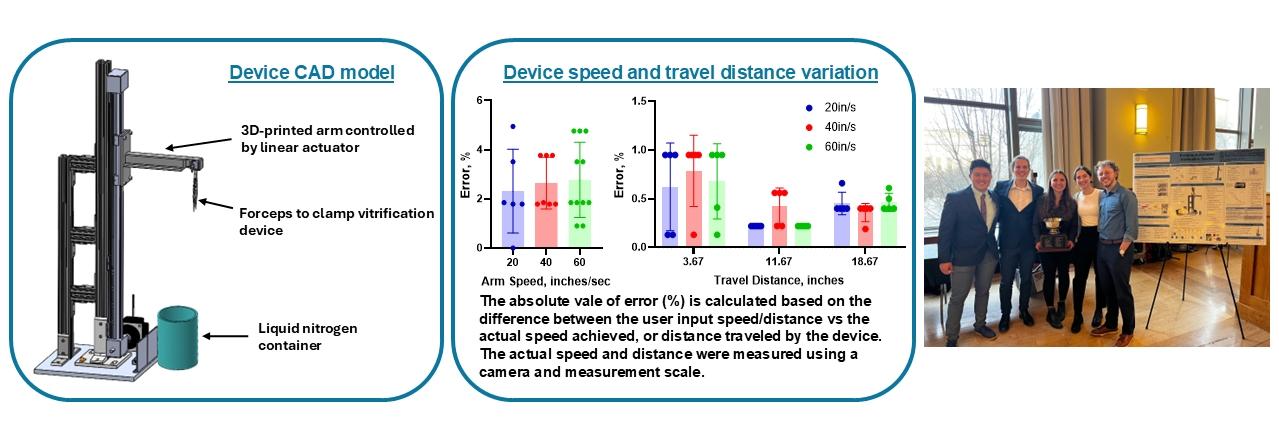
The device that the students developed consists of a stepper motor that drives the linear actuator, which is attached to an acrylic base and an aluminum spine for stability. The linear actuator enables the movement of a 3-D printed arm that is used to submerge the specimen rapidly into the liquid nitrogen. The device’s computer systems give operators full control over the system and allow them to customize desired parameters. The entire device can be manufactured for under $1500.

Location
Minneapolis, Minnesotawebsite
Start Year
Biotechnology and Healthcare


Biotechnology and Healthcare
Lead Institution
Core Partners
Fact Sheet
Outcome/Accomplishment
The NSF-funded Engineering Research Center (NSF ERC) for Advanced Technologies for the Preservation of Biological Systems (NSF ATP-Bio) is co-led by the University of Minnesota and Massachusetts General Hospital (MGH). Two faculty members at MGH sponsored a team of undergraduate Engineering Capstone students at Northeastern University (NEU) in a research project to develop an affordable, automated device for freezing (vitrifying) specimens in liquid nitrogen, resulting in higher experiment success rates. The team was awarded the Best Capstone Project in the Bioengineering Department at NEU.
Location
Minneapolis, Minnesotawebsite
Start Year
Biotechnology and Healthcare
Biotechnology and Healthcare
Lead Institution
Core Partners
Fact Sheet
Impact/benefits
Submersion of biological specimens in a liquid nitrogen bath is a highly variable technique, depending on experimenter technique and experience. This can be a major challenge, as minor differences in submersion speed can cause the procedure to either succeed or fail. Having an affordable, easy-to-build device can solve this issue.
Explanation/Background
The device that the students developed consists of a stepper motor that drives the linear actuator, which is attached to an acrylic base and an aluminum spine for stability. The linear actuator enables the movement of a 3-D printed arm that is used to submerge the specimen rapidly into the liquid nitrogen. The device’s computer systems give operators full control over the system and allow them to customize desired parameters. The entire device can be manufactured for under $1500.