The Grand Challenge Research Building in Arizona Opens to an NSF ERC
Outcome/Accomplishment
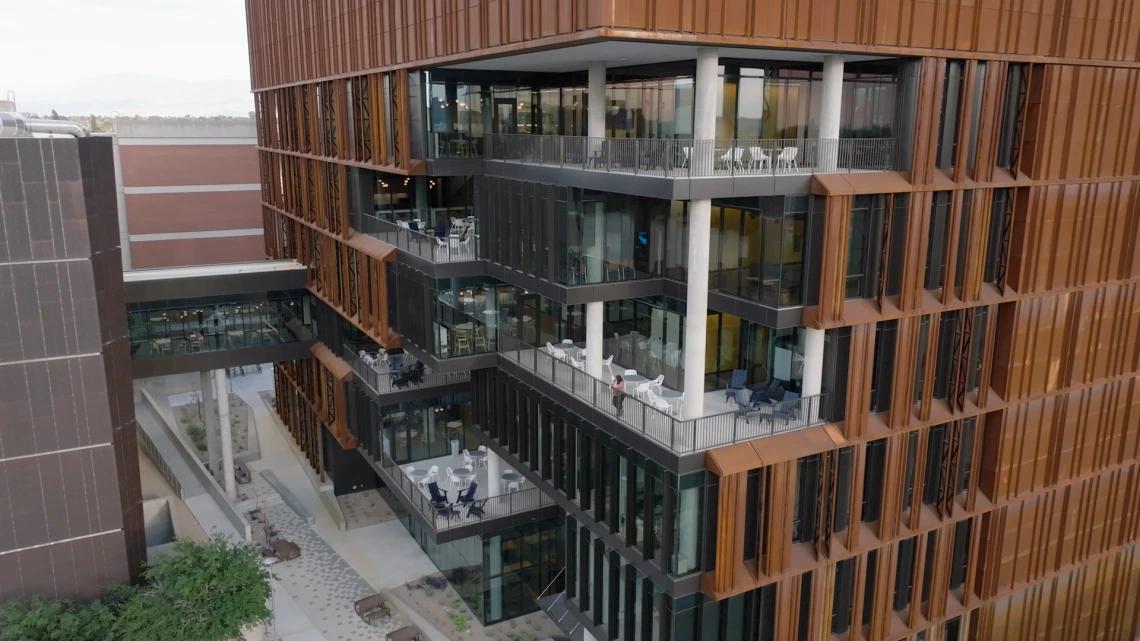
The headquarters of The Center for Quantum Networks (CQN), a National Science Foundation (NSF)-funded Engineering Research Center (ERC), has moved to the recently constructed Grand Challenge Research Building (GRCB) at the University of Arizona (U of A). A dedicated space for the Center is just one part of a world class facility that houses cutting edge research in emerging fields.
Impact/Benefits
U of A is also home to the Arizona Quantum Initiative (AQuI) and the Tucson Quantum Network System Testbed. The open and highly collaborative space has led to advancements in research and academic development alike. NSF CQN and U of A have begun offering a master’s degree in quantum information and science engineering (QISE), something made possible with the new advanced facilities in the GCRB.
Explanation/Background
The GCRB encompasses 115,000 square feet spread across seven stories. NSF CQN moved their headquarters to the fourth floor in May 2024. The modern, highly collaborative space also houses other institutes like the James C. Wyant College of Optical Sciences, the New Frontiers of Sound Science and Technology Center, the Center for Biomedical Informatics and Biostatistics and the Space4 Center.
The site broke ground in the autumn of 2021 and the grand opening ceremony for the GCRB took place on October 24, 2024. Designed by ZGF Architects and BWS Architects and constructed by Kitchell Contractors Inc., the project fulfils a promise by U of A leadership to provide a dedicated facility for NSF CQN and other emerging fields in a way that supports the U of A’s mission as a flagship and land-grant research institution.

Location
Collage Park, MDwebsite
Start Year
Microelectronics and IT


Quantum, Microelectronics, Sensing, and IT
Lead Institution
Core Partners
Fact Sheet
Outcome/Accomplishment
The headquarters of The Center for Quantum Networks (CQN), a National Science Foundation (NSF)-funded Engineering Research Center (ERC), has moved to the recently constructed Grand Challenge Research Building (GRCB) at the University of Arizona (U of A). A dedicated space for the Center is just one part of a world class facility that houses cutting edge research in emerging fields.
Location
Collage Park, MDwebsite
Start Year
Microelectronics and IT
Quantum, Microelectronics, Sensing, and IT
Lead Institution
Core Partners
Fact Sheet
Impact/benefits
U of A is also home to the Arizona Quantum Initiative (AQuI) and the Tucson Quantum Network System Testbed. The open and highly collaborative space has led to advancements in research and academic development alike. NSF CQN and U of A have begun offering a master’s degree in quantum information and science engineering (QISE), something made possible with the new advanced facilities in the GCRB.
Explanation/Background
The GCRB encompasses 115,000 square feet spread across seven stories. NSF CQN moved their headquarters to the fourth floor in May 2024. The modern, highly collaborative space also houses other institutes like the James C. Wyant College of Optical Sciences, the New Frontiers of Sound Science and Technology Center, the Center for Biomedical Informatics and Biostatistics and the Space4 Center.
The site broke ground in the autumn of 2021 and the grand opening ceremony for the GCRB took place on October 24, 2024. Designed by ZGF Architects and BWS Architects and constructed by Kitchell Contractors Inc., the project fulfils a promise by U of A leadership to provide a dedicated facility for NSF CQN and other emerging fields in a way that supports the U of A’s mission as a flagship and land-grant research institution.