Designing Radio Waves that Can Automatically Heal Their Own Connection
Outcome/Accomplishment
Researchers developed a novel theoretical foundation for designing waveforms that can preserve connections in wireless networks amid today’s crowded airwaves in research funded by the Center for Smart Streetscapes (CS3), an NSF-funded Engineering Research Center (ERC) based at Columbia University.
Impact/Benefits
Reliable wireless network connections are crucial for creating livable and safe communities through real-time, hyper-local streetscape applications. Scientists at CS3 achieved the first-ever, high-throughput low-latency, full-duplex spread-spectrum link that uses a system-on-a-chip platform and supports the recording and playback of uncompressed high-definition video.
Explanation/Background
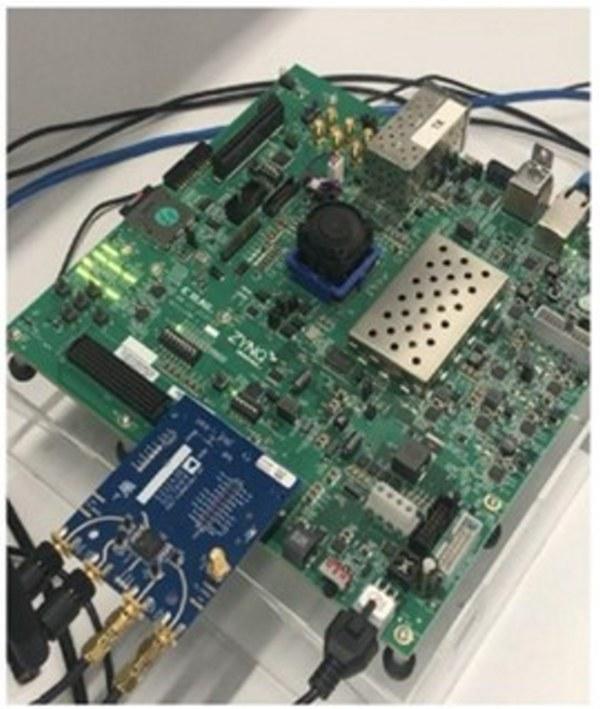
Multiple-input multiple-output (MIMO) technology is well understood as a crucial component in 5G and future communications. Using a Center testbed and a Radio Frequency System on a Chip (RFSoC), NSF CS3 investigators designed and implemented a new broad-spectrum link that uses MIMO frequency-division-duplex (FDD)—and demonstrated real-time, high-definition video streaming.
The researchers addressed the challenge of creating a dynamic MIMO link over a fixed wireless band amid widespread interference. The resulting publications highlighted how optimized waveforms can help maintain “clean” communications in extreme interference environments, which is crucial to autonomous, machine-to-machine communications. The team’s formal theory publication (in the IEEE Journal on Selected Areas in Communications, Special Issue on Electromagnetic Signal and Information Theory for Communications) was selected and discussed as a Research Highlight by Nature Reviews (May 2024). For more detail, see S. Naderi, D. A. Pados, G. Sklivanitis, E. S. Bentley, J. Suprenant, and M. J. Medley, “Self-optimizing near and far-field MIMO transmit waveforms,” IEEE J. Sel. Areas Commun., vol. 42, no. 6, Art. no. 6, Jun. 2024, doi: 10.1109/JSAC.2024.3389123.
Location
New York City, NYwebsite
Start Year
Microelectronics and IT


Quantum, Microelectronics, Sensing, and IT
Lead Institution
Core Partners
Fact Sheet
Outcome/Accomplishment
Researchers developed a novel theoretical foundation for designing waveforms that can preserve connections in wireless networks amid today’s crowded airwaves in research funded by the Center for Smart Streetscapes (CS3), an NSF-funded Engineering Research Center (ERC) based at Columbia University.
Location
New York City, NYwebsite
Start Year
Microelectronics and IT
Quantum, Microelectronics, Sensing, and IT
Lead Institution
Core Partners
Fact Sheet
Impact/benefits
Reliable wireless network connections are crucial for creating livable and safe communities through real-time, hyper-local streetscape applications. Scientists at CS3 achieved the first-ever, high-throughput low-latency, full-duplex spread-spectrum link that uses a system-on-a-chip platform and supports the recording and playback of uncompressed high-definition video.
Explanation/Background
Multiple-input multiple-output (MIMO) technology is well understood as a crucial component in 5G and future communications. Using a Center testbed and a Radio Frequency System on a Chip (RFSoC), NSF CS3 investigators designed and implemented a new broad-spectrum link that uses MIMO frequency-division-duplex (FDD)—and demonstrated real-time, high-definition video streaming.
The researchers addressed the challenge of creating a dynamic MIMO link over a fixed wireless band amid widespread interference. The resulting publications highlighted how optimized waveforms can help maintain “clean” communications in extreme interference environments, which is crucial to autonomous, machine-to-machine communications. The team’s formal theory publication (in the IEEE Journal on Selected Areas in Communications, Special Issue on Electromagnetic Signal and Information Theory for Communications) was selected and discussed as a Research Highlight by Nature Reviews (May 2024). For more detail, see S. Naderi, D. A. Pados, G. Sklivanitis, E. S. Bentley, J. Suprenant, and M. J. Medley, “Self-optimizing near and far-field MIMO transmit waveforms,” IEEE J. Sel. Areas Commun., vol. 42, no. 6, Art. no. 6, Jun. 2024, doi: 10.1109/JSAC.2024.3389123.