Evaluation of Cardiac Tissue-engineered Patch
Outcome/Accomplishment
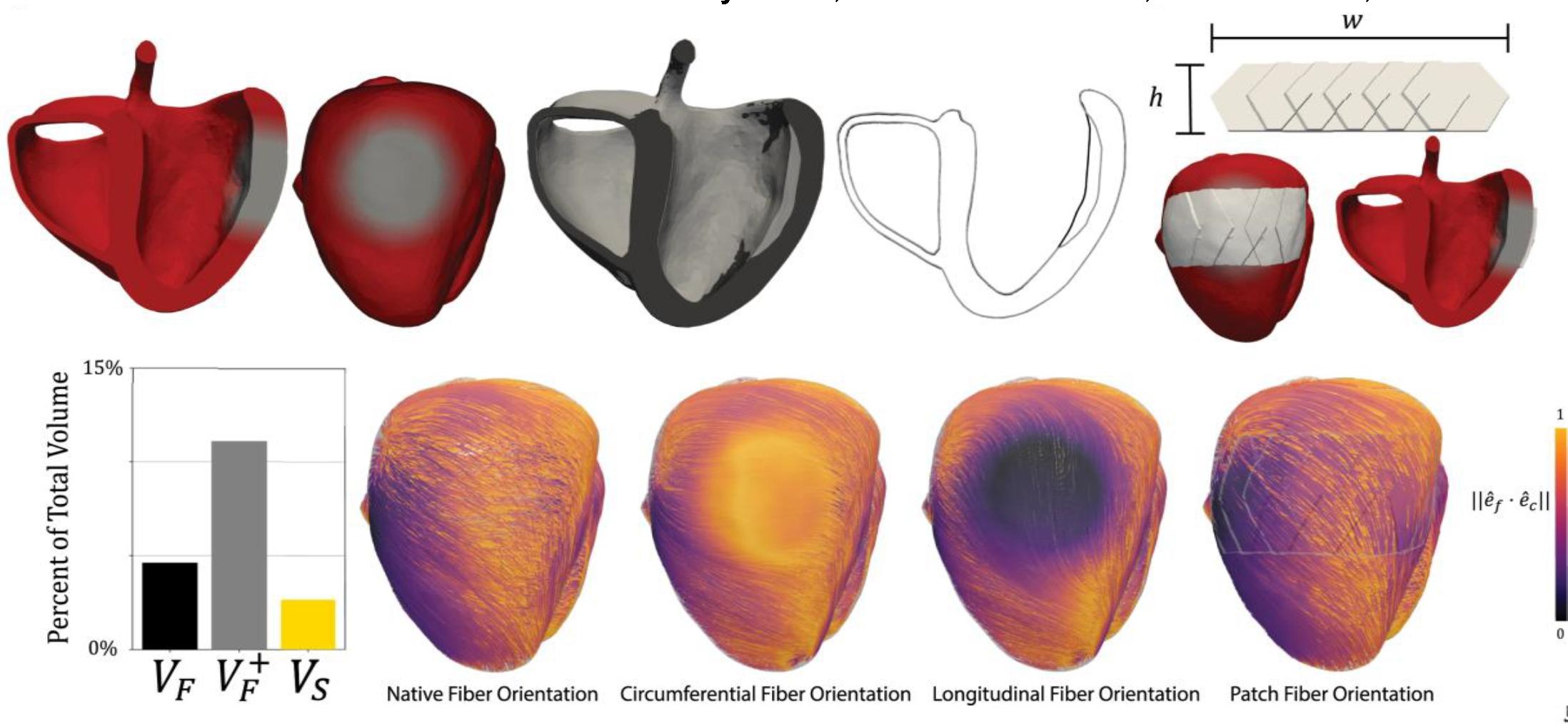
Researchers at the National Science Foundation (NSF)-funded Cellular Metamaterials (NSF CELL-MET) Engineering Research Center (ERC) have developed computational models using biventricular heart geometries to investigate the impact of engineered cardiac tissue patches. Their work revealed that patches exhibiting native muscle fiber alignment and higher active stress generation significantly enhanced cardiac function, particularly in transmural applications. CELL-MET is based at Boston University, the University of Michigan, and Florida International University.
Impact/Benefits
Surface patches provided modest functional benefits, especially in thinned regions, despite limiting diastolic filling. These findings identify critical design strategies—active stress generation and cardiac muscle fiber alignment—for optimizing cardiac tissue patches to restore heart function after myocardial infarction.
Explanation/Background
NSF CELL-MET’s research team included John Patrick Sayut Jr., Javiera Jilberto, Mia Bonini, Marc Hirschvogel, Will Zhang, David Nordsletten. The resulting paper was published at Sayut et al., Computers in Biology and Medicine, 2025 https://doi.org/10.1016/j.compbiomed.2025.111249

Location
Boston, MassachusettsStart Year
Biotechnology and Healthcare


Biotechnology and Healthcare
Lead Institution
Core Partners
Fact Sheet
Outcome/Accomplishment
Researchers at the National Science Foundation (NSF)-funded Cellular Metamaterials (NSF CELL-MET) Engineering Research Center (ERC) have developed computational models using biventricular heart geometries to investigate the impact of engineered cardiac tissue patches. Their work revealed that patches exhibiting native muscle fiber alignment and higher active stress generation significantly enhanced cardiac function, particularly in transmural applications. CELL-MET is based at Boston University, the University of Michigan, and Florida International University.
Location
Boston, MassachusettsStart Year
Biotechnology and Healthcare
Biotechnology and Healthcare
Lead Institution
Core Partners
Fact Sheet
Impact/benefits
Surface patches provided modest functional benefits, especially in thinned regions, despite limiting diastolic filling. These findings identify critical design strategies—active stress generation and cardiac muscle fiber alignment—for optimizing cardiac tissue patches to restore heart function after myocardial infarction.
Explanation/Background
NSF CELL-MET’s research team included John Patrick Sayut Jr., Javiera Jilberto, Mia Bonini, Marc Hirschvogel, Will Zhang, David Nordsletten. The resulting paper was published at Sayut et al., Computers in Biology and Medicine, 2025 https://doi.org/10.1016/j.compbiomed.2025.111249